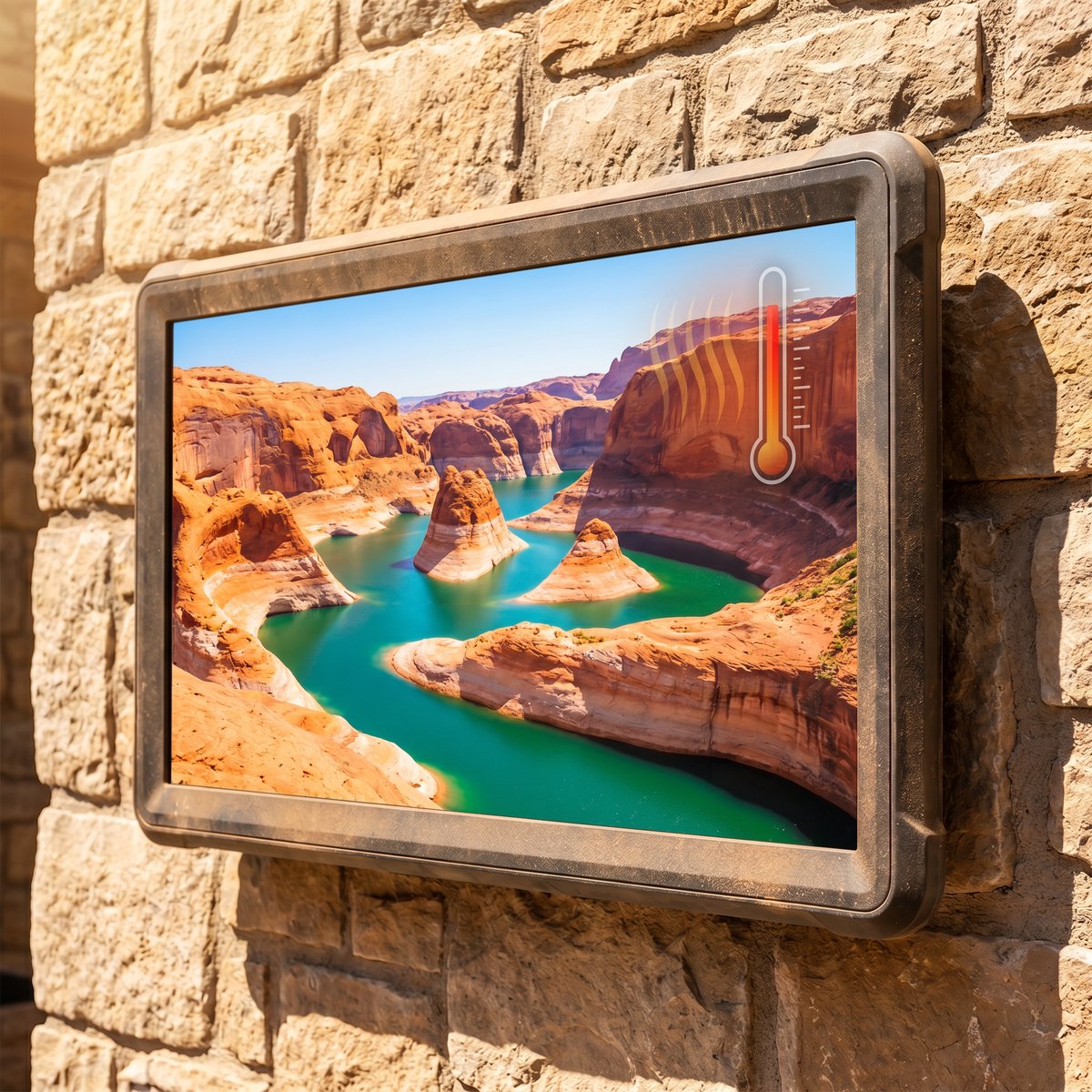
Best Outdoor TV for Cold Climates (2026)
TL;DR
For year-round outdoor mounting in cold-winter climates (Northeast, Midwest, Mountain West, anywhere winters drop below 32°F), the right TV must explicitly rate to −30°C / −22°F operating temperature or lower. Most outdoor TVs do; some don’t. Our picks:
- Best Overall: SunBriteTV Veranda 3 — $1,699. Rated −31°C, 5-year warranty, Dolby Vision.
- Best for Direct Sun: Furrion Aurora Full-Sun Pro — $6,999. Rated −31°C to 60°C, 2,500 nits.
- Best Budget: Sylvox Patio (50”) — $1,199. Rated −30°C, fully shaded use only.
⚠️ Important honest disclosure: the ByteFree BF-55ODTV — which we recommend for partial-sun mild climates — is rated 0°C / 32°F minimum operating temperature and is NOT suitable for year-round mounting in cold-winter climates. ByteFree positions for three-season outdoor use; for true year-round cold tolerance, choose one of the picks above.
What “Cold Climate” Means for an Outdoor TV
Outdoor TV operating temperature is measured at the panel surface during operation. Cold weather affects:
- LCD response time — at low temperatures, liquid crystal becomes sluggish, causing motion blur and ghosting
- LED backlight uniformity — cold spots create visible brightness banding
- Capacitor lifespan — electrolytic caps degrade faster in repeated freeze-thaw cycles
- Sealant flexibility — gaskets shrink in cold, breaking water-tight seal over years
A TV rated to −30°C / −22°F is engineered with:
- Cold-tolerant LCD layer (different LC material)
- Heated panel pre-warm cycle on power-on
- Industrial-grade capacitors
- Silicone gaskets that retain flexibility at low temps
This engineering adds roughly $200-$400 to the BOM cost, which is why “cold-rated” outdoor TVs are typically $200+ more than mild-climate-only models.
How to Read Your Climate
| Region | Typical Winter Low | Cold-Rated TV Required? |
|---|---|---|
| Florida, Gulf Coast | 50°F+ | No |
| California (Coast) | 45°F+ | No |
| Texas, Arizona, Carolinas, Pacific Northwest | 30-40°F | Marginal — bring inside or accept seasonal use |
| Mid-Atlantic (NY, PA, NJ) | 10-30°F | Yes |
| Midwest (IL, OH, MI) | -10 to 20°F | Yes |
| Northeast (MA, VT, ME) | -20 to 10°F | Yes |
| Mountain West (CO, MT, WY) | -25 to 0°F | Yes |
| Upper Midwest (MN, WI, ND) | -35 to -10°F | Yes (premium tier required) |
If your region appears in the bottom-half rows, operating temperature is the deciding spec for outdoor TV selection.
The Real Cold-Rated Outdoor TV Picks
🏆 Best Overall: SunBriteTV Veranda 3 — $1,699
The 55-inch SunBriteTV Veranda 3 is purpose-built for year-round outdoor mounting in cold climates:
- Operating temperature: −31°C to 40°C (−24°F to 104°F)
- Brightness: 1,000 nits — fine for partial sun in shorter winter days
- HDR: Dolby Vision support
- Warranty: 5-year (industry-leading for outdoor TVs)
- OS: Android TV
- IP rating: IP55
The trade-off vs ByteFree: 1,000 nits is below partial-sun-rated. Acceptable for most northern installations because winter sun is weaker and shorter.
Best for Direct-Sun Cold Climates: Furrion Aurora Full-Sun Pro — $6,999
For installations that face full sun AND need to survive cold winters (e.g., south-facing patios in Colorado):
- Operating temperature: −31°C to 60°C (−24°F to 140°F) — widest range in the category
- Brightness: 2,500 nits — handles direct sun
- IP rating: IP66 — premium weatherproof
- OS: WebOS
The trade-off: $6,999 is real money, and Furrion Aurora line skips Dolby Vision support. Worth it for genuine all-day-direct-sun + harsh-winter installations.
Best Budget: Sylvox Patio (50”) — $1,199
Sylvox Patio at 700 nits is shade-only, but it’s cold-rated to −30°C / −22°F. For fully covered porches in cold-winter regions, this is the cheapest legitimate option:
- Operating temperature: −30°C to 50°C
- Brightness: 700 nits (shade only)
- HDR: None
- IP rating: IP55
- OS: Google TV
Skip if you have any direct sun exposure — at 700 nits the screen washes out immediately.
Step-Up: Sylvox DeckPro 2.0+ — $1,599
For partial-sun cold-climate installations:
- 1,000 nits (more usable than Patio’s 700)
- −30°C to 50°C operating range
- IP55, Google TV
- No HDR support
Why ByteFree BF-55ODTV Isn’t on This List
We have to be honest: the ByteFree BF-55ODTV, which we recommend for many other use cases, is rated to 0°C / 32°F minimum operating temperature. It’s designed for three-season use in mild climates, not year-round cold-winter mounting.
The good news:
- ByteFree’s storage temperature goes to −20°C / −4°F. The TV survives cold winter storage in an unheated garage.
- For 3-season use (spring through fall) in cold regions, ByteFree works fine — you just bring it inside or cover it before the first hard frost.
The bad news:
- For permanent year-round outdoor mounting in cold climates, ByteFree is the wrong pick. Choose SunBriteTV Veranda 3 or Sylvox lineup instead.
This honest framing matters: a $1,499 ByteFree that fails at −10°F is more expensive than a $1,699 SunBriteTV that survives. Match the spec to your climate.
What to Verify Before Buying
- Operating temperature on the spec sheet (not the marketing page)
- Storage temperature (separate spec, usually wider — but matters if you’ll bring the TV inside)
- Warranty includes outdoor cold-climate installation (some warranties exclude installations below freezing — read the fine print)
- Cooling system handles winter (active fans on a cold-rated TV cycle very slowly to avoid thermal shock)
- Storage cover available (cold-rated TVs typically ship with a winter cover; the ByteFree BF-55ODTV ships with a waterproof cover pouch but that’s for general weather, not winter storage)
Cold-Climate Installation Tips
1. Use a snow cover for winter storage
Even cold-rated TVs benefit from a winter cover that blocks ice accumulation on the screen. Most brands sell branded covers ($60-150).
2. Add a TV cover heater (optional)
For installations in extreme cold (-30°F+), a low-wattage heating pad inside the cover prevents thermal shock when the TV powers on.
3. GFCI with cold-rated weather cover
Standard outdoor GFCI outlets work fine, but the protective cover should be cold-rated to avoid cracking in winter.
4. Avoid mounting under deep eaves where ice can fall
Falling ice from gutters or roofs is a more common outdoor TV killer than cold itself. Mount where the path above is clear.
Frequently Asked Questions
Will a cold-rated TV work in tropical heat?
Yes. Cold-rated TVs typically have wider operating ranges (e.g., SunBriteTV Veranda 3 to 40°C, Furrion Aurora Pro to 60°C). The cold rating doesn’t compromise heat tolerance.
Can I install a non-cold-rated TV outside in winter and just cover it?
Yes for storage (TV powered off, in a cover), no for active use. Most non-cold-rated TVs survive cold storage to −20°C / −4°F. Operating below 32°F damages the panel even if the TV is “still working” — symptoms appear after a few weeks of repeated cold-running.
What about the ByteFree BF-55ODTV in a covered porch in cold climate?
Three options:
- Bring inside for winter — ByteFree’s storage range to −20°C makes covered storage fine
- Use seasonally (April-October) — works without modifications
- Don’t buy ByteFree — pick SunBriteTV Veranda 3 if year-round mounting matters
Are there outdoor TVs rated to even colder than −30°C?
Furrion Aurora Full-Sun Pro is rated to −31°C / −24°F — the coldest among major brands. Beyond that, you’re in commercial/industrial outdoor display territory, not residential.
Do cold-rated TVs cost more to operate?
Marginally. The pre-warm cycle adds ~5-10W during the first 5 minutes after power-on. Steady-state power consumption is the same as non-cold-rated.
Bottom Line
For year-round outdoor mounting in cold-winter climates (winters below 32°F), the right pick in 2026 is the SunBriteTV Veranda 3 at $1,699. The cold-rated chassis and 5-year warranty are worth the premium over warmer-climate options.
For mild climates (no sub-32°F winters), the ByteFree BF-55ODTV at $1,499 is a better pick — more brightness and Dolby Vision at lower price. Match the TV to your climate, not the other way around.
For broader 2026 picks across all climates, see our Best Outdoor TVs of 2026 buying guide.