Can I Put a Regular TV Outside? Honest Answer
TL;DR — Short Answer: No
You can put a regular indoor TV outside in a weatherproof cabinet. You shouldn’t, and the math doesn’t work even when it sounds like it should. Indoor TVs in outdoor cabinets fail in 6–18 months on average, voiding the warranty long before that. A purpose-built outdoor TV like the ByteFree BF-55ODTV at $1,499 is cheaper over a 5-year horizon than the indoor-TV-plus-cabinet path.
The four failure modes:
- Heat death — panels designed for room-temperature airflow cook in cabinets above 90°F.
- Condensation — sealed cabinets trap humidity that condenses inside the TV’s electronics.
- Voided warranty — every major indoor TV brand explicitly excludes outdoor installation.
- UV degradation — anti-glare coatings, plastic bezels, and IR remote sensors degrade fast under sun.
Below is the full engineering explanation and the cost comparison most people skip.
The 4 Failure Modes (in Order of Likelihood)
1. Condensation — The Silent Killer
Of the four failure modes, this is the most common — and the one cabinet sellers don’t mention.
Outdoor temperature swings dramatically: a typical American summer day cycles from 60°F at 5 AM to 90°F at 2 PM. A sealed cabinet retains daytime heat, then cools at night. As the cabinet cools, the warm humid air inside reaches its dew point, and water condenses on every cool surface — including the back of your TV’s main board.
Most failures appear in month 3–6:
- TV powers on, then resets randomly (water on input filtering)
- Vertical lines or color blocks on the screen (water on T-Con board)
- Total failure to power on (water on the SMPS power supply)
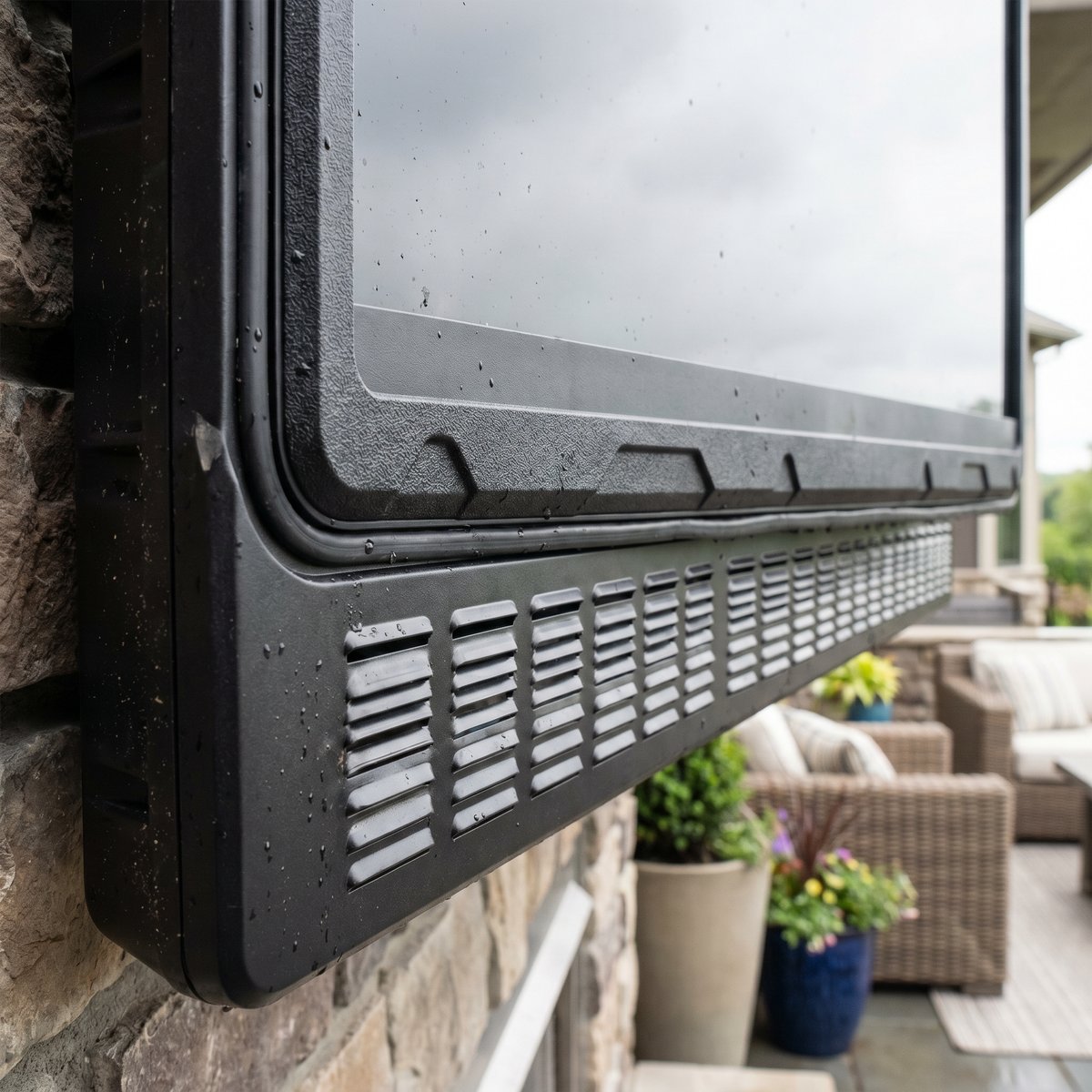
Vented cabinets reduce this slightly but don’t eliminate it. A purpose-built outdoor TV uses internal sealing combined with active fans — keeping the electronics at constant temperature and humidity. The ByteFree BF-55ODTV’s 4-fan cooling system explicitly handles this.
2. Heat Death — Thermal Throttling and Permanent Damage
Indoor TVs are designed for 20–25°C ambient room temperature with passive convection cooling — air rises around the chassis carrying heat away.
Inside an outdoor cabinet at 2 PM:
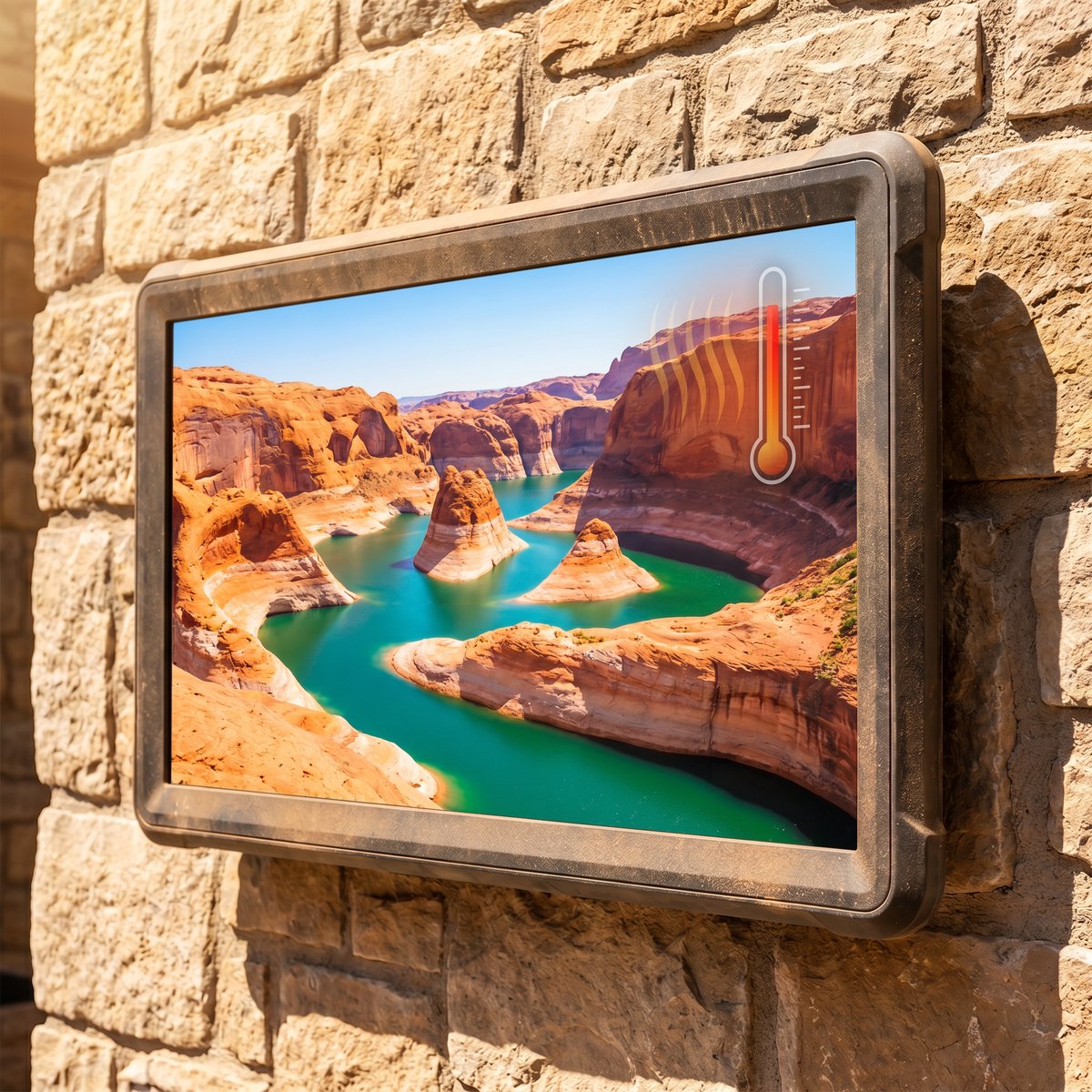
- Cabinet interior easily hits 115–130°F (46–54°C) in direct sun
- The TV’s panel temperature climbs another 20–30°F above ambient
- The TV’s silicon hits the thermal throttle threshold and dims to about 50% brightness
- Repeated thermal cycles permanently damage LED uniformity and panel longevity
Indoor TVs panel-rated for 50,000 hours typically fail at 8,000–15,000 hours under outdoor cabinet conditions. Outdoor TVs rated for 50,000 hours are designed for these conditions — the ByteFree BF-55ODTV’s panel lifetime spec is 50,000 hours under outdoor operating conditions.
3. Voided Warranty — The Legal Reality
Read the warranty terms for any consumer indoor TV brand:
- Samsung: “Damage caused by exposure to moisture or excessive heat is not covered.”
- LG: “Outdoor installation or use voids this warranty.”
- Sony: “Use only in environments specified in the user manual; outdoor use is not supported.”
- TCL: “Damage from improper installation, including outdoor placement, is excluded.”
When (not if) the indoor TV in your outdoor cabinet fails, the manufacturer will not cover it. Outdoor TV brands like ByteFree explicitly support outdoor installation in their warranty terms.
4. UV Degradation — Slow but Inevitable
UV light damages:
- Anti-glare coatings (yellow within 2–3 summers under direct sun)
- Plastic bezels (warp and discolor)
- IR remote sensors (degrade, lose responsiveness)
- Internal LCD polarizers (pinhole damage from concentrated light through cabinet glass)
A properly designed outdoor TV uses UV-stabilized polymers, anti-yellowing coatings, and anti-reflective tempered glass — engineering that costs ~$80–$120 per TV at production. An indoor TV bought for outdoor use does not have these protections.
The Math: Indoor TV + Cabinet vs Outdoor TV
People consider the indoor-TV path because at first glance it looks $400–$600 cheaper. Counting realistic 5-year ownership costs flips the answer:
| Cost Item | Indoor TV + Cabinet | ByteFree BF-55ODTV |
|---|---|---|
| TV (55-inch) | $400 (mid-range indoor 4K) | $1,499 |
| Weatherproof cabinet | $250 | $0 (TV is the enclosure) |
| Mounting | $80 | $80 (VESA bracket) |
| Outdoor surge protector | $40 | $40 |
| Year 0 subtotal | $770 | $1,619 |
| Replacement TV (year 1.5 average failure) | $400 | — |
| Replacement TV (year 3) | $400 | — |
| Replacement TV (year 4.5) | $400 | — |
| 5-year total | $1,970 | $1,619 |
The indoor-TV path costs $351 more over five years, requires three TV replacements (each ~3 hours of installation work), and produces ~120 lbs of e-waste. The outdoor-TV path is the cheaper option even before factoring in any value of your time.
Edge Cases Where an Indoor TV Outside Might Work
Three specific scenarios are exceptions:
1. Fully Enclosed, Climate-Controlled Outdoor Room
If you have a screened-in three-season room with a heater, dehumidifier, and AC, that is not “outside” — it’s an unconditioned room, and a regular TV is fine.
2. Detached Garage or Shed (Covered, Ventilated, Mounted High)
If the TV is inside the garage, never sees direct sun or rain, and the garage stays above 50°F in winter, an indoor TV is OK. This is “indoor TV in an outbuilding,” not “outdoor TV.”
3. Renting / Short-Term Use
If you’re renting and will use the patio TV only one season before moving, the math changes — at one year of use, total ownership cost is roughly the same. A $400 indoor TV in a $250 covered cabinet for 9 months is acceptable, knowing you’ll replace the TV.
For everyone else with permanent installations, buy outdoor-rated.
What to Buy Instead
The right outdoor TV depends on your patio’s sun exposure (see How Many Nits Do You Need):
| Sun Exposure | Recommended Model |
|---|---|
| Full shade | Sylvox Patio (700 nits, $1,199) |
| Partial sun (most patios) | ByteFree BF-55ODTV (1,500 nits, $1,499) |
| Full sun all day | Sylvox Pool Pro 2.0+ (2,000 nits, $2,399) |
Compare the full lineup in our Best Outdoor TVs of 2026 buying guide.
Frequently Asked Questions
What about the “outdoor TV cabinets” sold on Amazon for $200?
These cabinets reduce the failure rate from “100% within 18 months” to roughly “70% within 24 months.” They help with rain but don’t address condensation or heat. The math still favors a real outdoor TV.
Can I just leave my indoor TV outside under a covered roof?
A covered roof handles rain but not condensation, humidity, UV, temperature swings, or pollen. Indoor TVs left under a covered patio still fail within 12–24 months on average — slightly slower than in a cabinet, but still inevitable.
What if I use an indoor TV only seasonally and store it indoors in winter?
The seasonal pattern reduces but does not eliminate the failure modes — you still get heat damage during summer, and the temperature shock when you bring a 90°F outdoor TV into a 70°F house creates condensation events. Expect failure within 3–4 summers, vs 6–8 years for a real outdoor TV.
Are there cheaper outdoor TVs under $800?
Yes — the Element EP500AE55C at $899 is the cheapest legitimate IP55-rated 55-inch outdoor TV. Brightness is 700 nits (shade-only). For partial sun under $1,500, the ByteFree BF-55ODTV remains the price leader.
Does the $400 used to “save” really matter when you can afford it?
Time and frustration matter too. Replacing a failed TV every 18 months means scheduling installation, dealing with mounting, recycling the broken one. Outdoor TVs simply work for 5+ years. The TCO math is the same; the time savings is the bonus.
Bottom Line
The “indoor TV in an outdoor cabinet” approach sounds smart but loses on every dimension — cost, longevity, warranty, e-waste, and your weekend time. Buy a purpose-built outdoor TV. For most American patios in 2026, the ByteFree BF-55ODTV at $1,499 is the cheapest path that actually works.
For a complete view of outdoor TV options across every price point, start with our Best Outdoor TVs of 2026 guide.